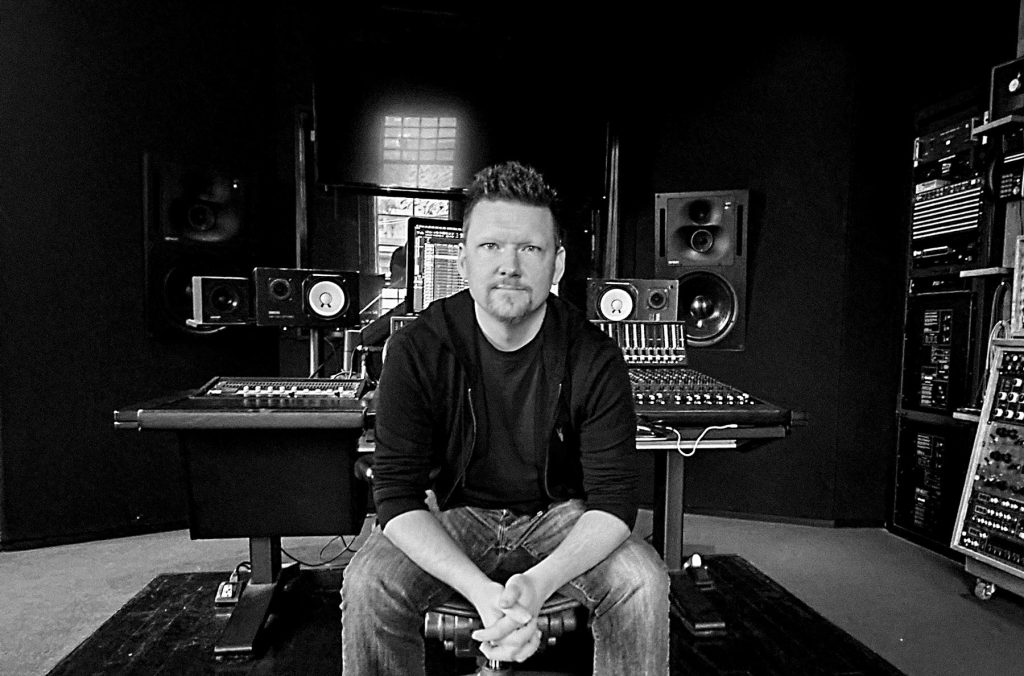
Photo: Clayton King
We caught up with composer and musician Jesse Zuretti to talk about his journey from metal to composing for Marvel and Riot Games, his creative process and which Toontrack tools he relies on to bring his music to life.
If we start from the beginning, where does your interest in music stem from?
Both sides of my family are deeply into music (and film). My dad in particular always showed me amazing music as a kid in the 1990s and early 2000s (Pat Metheny Group, Radiohead, Porcupine Tree, Morrissey, King Crimson, Frank Zappa, etc.). But even before learning about all of that, I realized I loved music as early as my first time seeing Beetlejuice and Batman (1989, Tim Burton) as a kid – maybe 1990/1991. The music connected with me and was almost as important (at the time) as the aesthetics of Tim Burton’s films. As an adult, the music is dominant in his films for me – but as a kid, the characters and scenery always blew my mind. I spent a lot of my allowance and kid-jobs buying music, anything from White Zombie and Stone Temple Pilots to Mazzy Star, Wu-Tang Clan and Sade.
Coming from a band background, how did you fall into composing for films and games? Was it always something that you had in the back of your mind and something you gravitated towards?
My band, Binary Code, slowly started making our way towards a more cinematic sound. By the time we got to our most recent release in 2020 (which we recorded in 2017), we were already full-tilt cinematic. But even before that, I started leaning into film for influence on the stories that I had in my head. We started out as a silly technical metal band in 2004 and just changed constantly. At this point, if I wrote another album, it’d be 100% cinematic, nothing for showmanship or technicality. Which leads to 2018, when I had my first chance to compose for Marvel. The person who graciously asked me to write music for them connected with me over the album my band released in 2020. It got the gears turning, and the career just kind of happened.
Your first gig for Marvel turned out to be hugely successful and even got you a Webby Award. From there, you’ve completed several other major projects. Out of all the projects you’ve worked on so far, which one stands out to you on a personal and professional level?
What we’ve done with Riot Games on 2XKO has been the stuff of dreams for me. On 2XKO, I helped shape a soundtrack built around League of Legends-based characters and stages, with wide stylistic ranges and live performances from both soloists and orchestra. We recorded a full orchestra at Ocean Way Studios in Nashville and brought in an incredible roster of musicians from around the world, including the main theme “Let’s Go” with the dudes in Polyphia, bassist Henrik Linder of Dirty Loops, Jacob Umansky of Intervals and Matt Heafy of Trivium, along with standout artists across classical, fusion, hip-hop, R&B, jazz and progressive music such as Ando San, Jack Gardiner, Grace Kelly, Brandon Acker, Owane and Ross Garren. But I will always love the grassroots nature of my work with Marvel early on. The series we won awards with was grown from personal conversations, so to see that happen and then win awards is monumental for fueling a career in composing.
Your productions range from orchestral to synth and metal – sometimes all combined and often with a dark and industrial twist. Out of all these styles, is there one you prefer or is it the combination that excites you?
One of the things about working with companies like Marvel or Riot is that you have to be able to do everything. And for anyone reading this who may be interested in composing – there are a few types of folks who get the gigs: those who can say “yes!” to anything and deliver a fantastic production – and those who can say “yes!” to things they are quantifiably the best at, and they deliver unparalleled productions of specific genres/styles. I enjoy doing EVERYTHING at this point. If you name a genre, I will find an example of something that I enjoy. I will always lean towards the darker side of music by nature – but I have truly enjoyed challenging my comfort zones with Riot. I think my favorite styles of metal to write are dissonant black metal (hugely into Deathspell Omega’s “Paracletus”), the styles the band Daath – for which I played guitar & composed on The Deceiver – does (virtuoso-centric orchestral progressive metal), post-metal (huge fan of Cult of Luna), but also stuff that melds influences of mine, like: Extol, Failure, Harm’s Way, Decapitated, Anata, Textures, etc.
“I truly love dark cinema – especially dark fantasy, horror and sci-fi.”
Working in all fields from series to games, trailers and traditional songwriting for bands, is there one you prefer? If so, why?
At this point, I prefer to write for games, but have a deep desire to push forward into film pretty heavily at some point soon. I’ve had some interest from film folks I really admire and I think that’s where I will end up long-term. And that’s only because it’s my first love for storytelling. Games are fantastic and I love how incredible the productions are, but I truly love dark cinema – especially dark fantasy, horror and sci-fi.
When composing for different media, does your process differ a lot depending on where the track you’re writing is supposed to end up? Is there a lot of creative freedom when writing for something that already has a narrative and a context, like a game, for example?
Absolutely, games prefer a much more predetermined approach to them; you can’t just write and expect it to work. You have to consider so many things, from sound design to Foley work, etc. – but also how it works transitionally when the action is driven by a human being. And when you’re working with any company who has a dedicated fanbase, characters, lore, etc., you have to respect all of that with every decision you make. We work with music guides and they’re written by incredibly intelligent musicians/composers who put a ton of time into musicology/ethnomusicology, research and theory into developing resources for us to work from. We have everything spelled out up to the music and then we have to basically be professional interpreters who translate the ideas of a greater team into music!
Walk us through a typical day of yours – on the job composing!
Most of the time, clients send over a brief that lays everything out. From there, my process is a lot like forensic profiling, except for music and the medium it’s living in. I figure out which instruments fit the character, the environment, the emotion, the setting, the scene and the story. Once that’s locked in, I just start sketching ideas. A lot of them show up in my head first, and I’ll hang onto them until I can get to a piano, a guitar or my DAW.
When it’s a synth-driven production, it’s pretty straightforward. I go to the synths I know like the back of my hand and start tinkering. Once I’ve got the core mapped out, I build around it so it fits however the music’s going to be used.
When it’s orchestral, it’s the same process, just with VST libraries I can really speak to. Once that’s in place, I humanize the mockup as much as I can before we track the orchestra or soloists. Then the compositions go to my wife, Sydney Kjerstad Zuretti, who arranges and orchestrates them for the players, and from there it’s off to George Lever or Joe Ford.
And if it’s a hybrid, which it usually is, I can tell pretty quickly which side is leading. The references in the brief usually make it obvious. Then it’s everything above, and the end goal is always the same: make the client happy.
“Toontrack have done the best job at making kits functional for writing, not just audiologically, but also functionally and technically speaking.”
You’ve been an avid Toontrack user for a long time. In your work, which products make the biggest difference and, overall, how do the programs help in your day-to-day work?
The greatest sign of my love for Toontrack is the Nemesis EZX library that George Lever & I worked on. We knew Toontrack was the best partner to help us create a library for people searching for the sounds we make for bands and soundtracks. It’s such an honor to go from being an early Toontrack user as a teenager in the early 2000s dreaming of making it in music to having a library with my sounds in it. Creating a toolkit that I’ve already been implementing into our record/soundtrack work is a dream come true. And making that available to anyone searching for a hybrid metal/rock/industrial sound that covers cinematic elements for the forward-thinking writer feels like a great way to contribute to helping people get their ideas out quicker and in higher quality.
Before that, I had never been afraid to admit how much I love Toontrack’s product line, and I have for nearly 25 years now. I’ve been using Toontrack since 2002 – I still have an install disc for Drumkit From Hell. And to this day, I still very actively use Toontrack, including when appropriate for clients who have budgets to hire live musicians.
EZkeys 2 in particular is one that my household uses (as only a few may know, my wife Sydney Kjerstad Zuretti is a fantastic pianist who helped launch EZkeys 2 with video performances). It sounds incredible and frankly blows away any recommended piano VST I’ve ever heard about. EZkeys 2 in particular has an environmental performance sound that simply doesn’t exist with other libraries – this is crucial for actual pianists. I can’t even begin to imagine how Toontrack will outdo that library. The ease and functionality of the EZdrummer 3 EZX libraries are always fabulous for quick, high-quality sounds I need in my workflows. I especially love the Synthwave EZX, Number 1 Hits and Hip-Hop EZX drum expansions. Toontrack has done the best job at making kits functional for writing, not just audiologically, but also functionally and technically speaking.