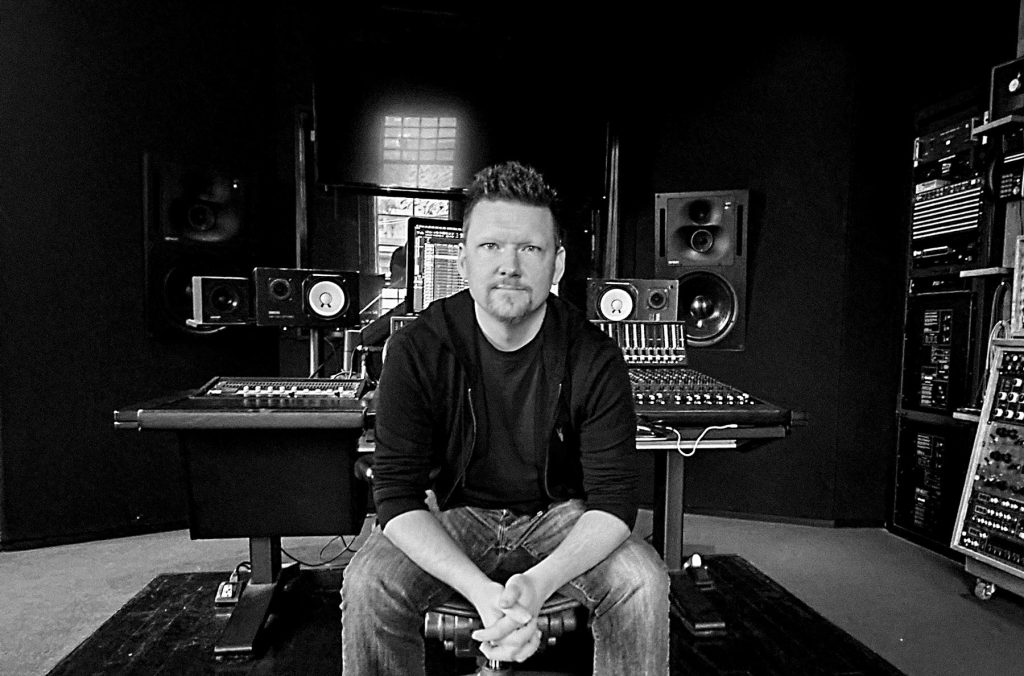
From making demos in his bedroom to producing landmark records like Sleep Token’s Sundowning, producer and mixer George Lever has carved out his own approach to music production. We caught up with him to talk about creativity, the art of building sonic worlds and his involvement in the creation of the Nemesis EZX.
If we rewind to the very beginning, what first sparked your interest in music?
Matt Bellamy has quite a lot to answer for. I was about fifteen and listening to a lot of Muse, Radiohead, King Crimson, the Beatles and Red Hot Chili Peppers. Honestly, the list was a lot longer than that. I just loved music and wanted to have a go at playing the songs myself. With Muse, my ambition was pretty modest. Could I get through the riff? And if I could, how on earth was Matt making that noise? I’ve made a career out of variations on that second question.
How did that eventually develop into an interest in recording, producing and mixing?
The band I was in at uni needed a demo. I had an iMac and just enough confidence to think, ‘Well, how hard can it be?’ The drums on that first demo came courtesy of Logic 8’s built-in sampler. I’d be quite curious to hear it again. Briefly.
We were gigging, so I knew other bands who needed demos. I’d offer to have a go, and each band gave me something different to figure out. When I left uni, I turned my dad’s garage into a studio. What kept me at it was this slightly frustrating thing where I could hear a band play and picture how good their record could sound. Then I’d record them and discover how much I still had to learn. I really wanted to hear the version in my head come out of the speakers. I still hear things I’d do differently when I put a record on a year later. These days I’ve got a better idea of how to get there.
Your work as a producer is sometimes described as sonic “world building.” How do you construct those worlds?
I studied graphic design and photography, so I tend to picture a record. If you put a voice right up against somebody’s ear, you’ve made a decision about where the listener is standing. Now, how far away are the drums? And what would it feel like if, for one hit, they were suddenly as close as the singer? I can get quite excited about a snare drum when you put it like that.
One thing I do with records I love is listen to the same passage three times. First time, I just enjoy it. Second time, I follow whatever caught my ear. Third time, I listen for what’s missing. Sometimes the thing that made a vocal line feel so intimate was the guitar player leaving a gap underneath it.
With a band, the clue is usually already in their demo. There’ll be one slightly odd thing they do that makes perfect sense when they do it. That’s the thing I want to hear more of. Once we’ve found it, it’s much easier to decide what belongs around it and what we can leave out.
Coming from a DIY background, without the resources or equipment of a big studio, you’ve had to carve out your own path. How important have tools like Superior Drummer been in that process?
Superior Drummer 2 was my drum education for a good while. I had The Metal Foundry, and from my bedroom I could push the room mics until I’d gone miles too far, pull them back and hear exactly where the kit started to feel exciting. Nobody was paying for the room. Nobody was waiting for me to finish. I could afford to be curious.
Then I got into a studio with a real kit and had quite a shock. The drums coming back through the mics were much darker than I expected, and there was all this other stuff coming through with them. That’s when I appreciated how much I’d learnt from Superior. I had a sound in my head to aim for and some idea of what to try first.
Not only in your personal discography, but in modern metal as a whole, Sleep Token’s Sundowning has become something of a milestone record. What made that particular project so special?
I have no idea how to put it into words, honestly. It will always be one of my favourite experiences as a professional. I really loved everything about that experience and outcome. I owe my career to it.
“The artist has got to be able to tell me if I’m wrong or if they disagree.”
Most producers have their own particular strengths, philosophies and ways of approaching a project. For you, what’s the single most important thing you insist on when producing a band?
The artist has got to be able to tell me if I’m wrong or if they disagree. I spent a fair bit of my early career being the loudest person in the room, then mistaking the subsequent silence for a unanimous vote. Took me a while to work that one out.
These days that conversation starts in the first email. Where do you want me to take the lead? What do you want to figure out together? And is there something in the demo that everyone keeps offering to fix and you secretly love? Please tell me about that bit. There’s usually a very good reason it’s survived every version of the song.
Which part of a production do you enjoy the most? Is it the initial phase of capturing the raw performances and getting the bones of the songs down, the creative process of adding overdubs, textures and layers, or the final mixing stage when everything comes together?
Give me that moment when the drummer is hearing the first proper take back through the speakers. You can spend ages tuning the kit, moving mics and asking somebody to hit the same snare drum again. Everyone involved has heard quite enough of that snare drum. Then they play the song, you hear the snare in the middle of a fill, and suddenly you know why you spent all that time on it.
I particularly like getting to hear that playback with the drummer. They’ve spent the whole morning on the other side of the glass. Now they get to sit where I’m sitting and hear what they’ve just done.
“You can get the space around a drummer sounding quite feral and still hear the detail of what they’re playing.”
You were integral to the creation of the Nemesis EZX for Toontrack. What was your vision going into the project, and what do you think this library brings to the table that was previously missing?
My test for a kit was fairly brutal. Put the guitars back in. Is the snare that sounded enormous on its own still doing anything for you? We took instruments from Death & Darkness and Infinity Grid, reworked them, captured that processing in the sounds and developed the presets in full mixes. One of my favourite controls lets you drive the room separately from the shells. You can get the space around a drummer sounding quite feral and still hear the detail of what they’re playing.
Then there’s Jesse Zuretti’s side of it. He hears things as a soundtrack composer. Between us, we wanted an instrument where you could write the groove, find the impact that brings in the next section and have both feel like they came from the same record. That’s what I’d have wanted in my own sessions.
Toontrack gave me my first endorsement back in 2011. I was using Superior Drummer to make demos like I said, and here was someone at Toontrack saying they wanted to back me. I wrote back and told him he’d pretty much made my year. I also said I’d let him know if I ever had any ideas for product updates. Fifteen years on, Toontrack, I think Nemesis counts.
The thought that someone can sit in their bedroom now, learning their version of my story, pushing the room mics too far on a kit, messing around with all the macros to make ultimate chaos using a kit Jesse and I helped make, is pretty wild. I know exactly how much fun they can have in there.
When you sit down to mix a song, where do you typically start? Drums, guitars, vocals or something else entirely? Do you have a set routine you normally stick to, or does each song dictate its own approach?
I play the rough from the band and try to get through the whole thing before I touch anything. You only get one listen where you don’t know what’s coming. I want to know where I leaned in, where my attention wandered and which bit I’d be genuinely upset to lose. Then I’ll put a reference on to get my bearings.
As for the first fader, that depends. Say the chorus comes in and feels a bit small. My first move might be to go backwards and see what the guitars are doing just before it. If they’ve already given you the whole chorus half a bar early, you can spend a very long afternoon blaming the kick drum.
Finally, what is the best thing about working with music?
The people. I can hear a particular fill years later and remember who was sitting next to me when we played it back. Then you meet someone who loves that same song, and to them it’s a completely different memory. They can tell you where they were living, who they were with, what was going on in their life when they heard it. I got to be there when we made it, and they’ve had a whole life with it since. I love hearing what happened to a record after it left my room.